Subterranean termite pressure in Mecklenburg County remains intense due to warm humid summers and dense red clay soil profiles that retain sub-surface moisture. Eastern subterranean termites navigate subterranean…
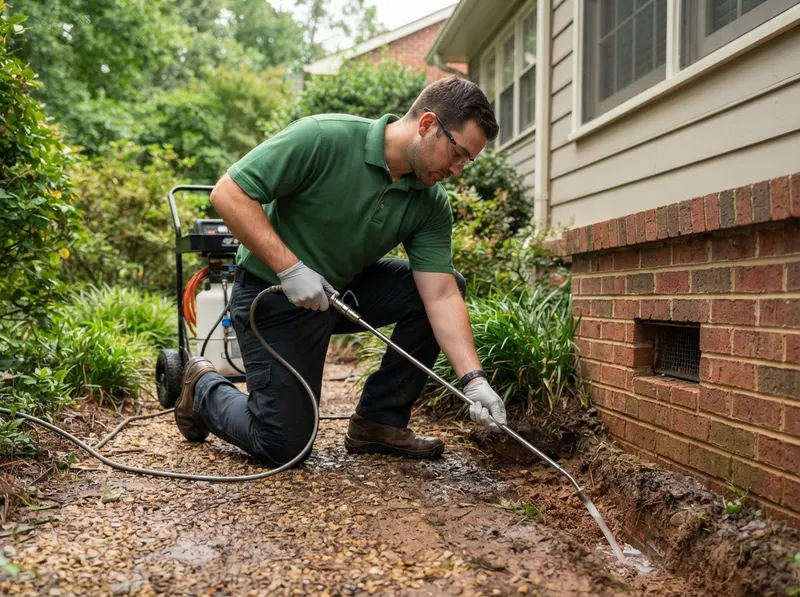
Subterranean termite pressure in Mecklenburg County remains intense due to warm humid summers and dense red clay soil profiles that retain sub-surface moisture. Eastern subterranean termites navigate subterranean moisture gradients near foundation perimeters, building mud tubes over brick masonry stem walls in historic Dilworth and Elizabeth bungalows as well as modern poured-concrete foundations in Ballantyne. A proper soil barrier remediation involves creating a continuous continuous treated zone beneath and alongside foundation footings. Technicians excavate a continuous 6-inch-wide by 6-inch-deep trench directly against exterior foundation walls, flooding the trench with 4 gallons of non-repellent liquid emulsion per 10 linear feet. For crawl space construction common in Myers Park and Cotswold, interior piers require identical 4-gallon perimeter saturation to halt insect movement up central support columns.
Selecting between a liquid soil barrier and an exterior bait monitoring network depends on property layout and drainage conditions. Non-repellent liquid soil treatments establish an immediate lethal perimeter that foraging termites pass through unknowingly, transferring the active ingredient back to the central subterranean brood chamber. This method fits structures with exposed soil lines and accessible crawl spaces. However, when finished basements, expansive flagstone patios, or complex concrete walkways surround a South End or Plaza Midwood property, sub-slab drilling every 12 inches is required to saturate underlying soil. For steep river-adjacent parcels near the U.S. National Whitewater Center or saturated creek banks along Little Sugar Creek Greenway, an in-ground bait station array spaced every 10 to 15 linear feet serves as a non-disruptive alternative, eliminating colonies through insect growth regulators without heavy trench excavation.
Homeowners frequently confuse subterranean termite remediation with standard drywood termite surface dusting or basic interior pest spraying. Subterranean termites dwell primarily underground in soil reservoirs and enter framing timber strictly to harvest cellulose, meaning surface sprays inside living rooms fail to address the external colony source. Remediating subterranean populations requires high-volume volume-metered soil saturation to prevent structural timber degradation. Liquid barrier installations remain stable within undisturbed clay soils for 5 to 8 years, though major landscaping disruptions, additions, or regrading projects near foundation walls can compromise the continuity of the protective chemical envelope.
Every job gets a firm, written price after a free on-site visit.
Tell us about your subterranean termite treatment and soil barrier remediation job in Charlotte and we'll send a clear, written quote, usually the same day.
 SafeHaven Pest Control